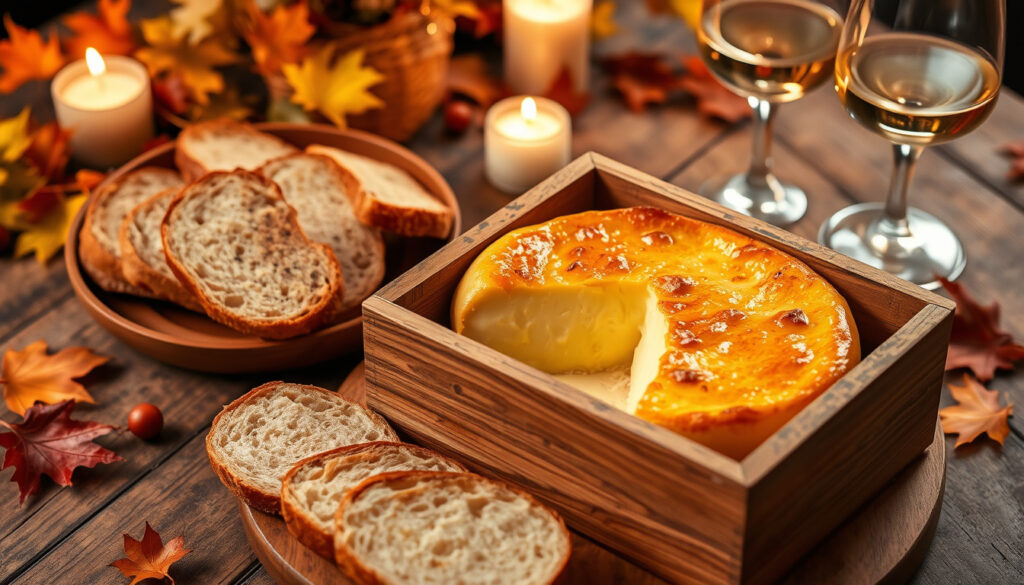
Mont d’Or: How to Bake, Eat, and Enjoy This Seasonal Cheese
There’s a moment each autumn when cheese lovers start checking their local shops, and it’s usually for one reason: Mont d’Or has arrived. This soft, spoonable cheese wrapped in spruce bark only appears for a few months a year, and its limited season is part of what makes it so special.
Production season: August to March ·
Milk type: Raw cow’s milk ·
AOC status: Protected since 1981 ·
Rind material: Spruce bark ·
Ideal baking time: 20-25 minutes at 350°F
Quick snapshot
- Seasonal cheese made from raw cow’s milk (Vacherin Mont-d’Or official PDO site)
- Produced in Jura region of France and Switzerland (GOV.UK protected food drink names)
- Ripened in a spruce bark box (The Cheeseboard)
- AOC since 1981 (GOV.UK protected food drink names)
- Exact historical origin of the baked recipe
- Specific nutritional data from a single official source
- Precise production window variations between French and Swiss PDO rules
- The exact date of AOC status (1981) is not confirmed in official sources
- The exact start of traditional production in the early 20th century is not documented
- The exact temperature and time for baking are not standardized across recipes
- Production: 15 August to 31 March (Vacherin Mont-d’Or official PDO site)
- Sale period: September to April (Vacherin Mont-d’Or specification sheet PDF)
- AOC registration: 21 June 1996 (GOV.UK protected food drink names)
- Traditional production since early 20th century (Vacherin Mont-d’Or official PDO site)
- Season returns August 2025
- Best buying window: October to January
- Baked Mont d’Or trend growing on social media
Here are the key characteristics of Mont d’Or.
| Attribute | Value |
|---|---|
| Cheese Type | Soft, washed-rind, cow’s milk cheese |
| Production Season | Exclusively produced from August to March |
| Geographical Indicator | Protected Appellation of Origin (AOC) in France |
| Distinct Feature | Ripened and sold in a spruce bark box |
| Flavor Profile | Rich, creamy, slightly tangy with a hint of pine |
What kind of cheese is Mont d’Or?
Mont d’Or is a soft, rich, seasonal cheese made from cow’s milk, produced in the Jura region of France and Switzerland (GOV.UK protected food drink names). It belongs to the washed-rind family but behaves more like a bloomy-rind cheese — a paradox that gives it its unique texture. The cheese is only made between August and March, a tradition tied to the alpine cycle when cows descend from high pastures and their milk becomes available for this specific production (Wikipedia article).
How is Mont d’Or made?
The process starts with milk delivered twice daily to the cheese dairy (AOP-IGP.ch). The official PDO specification requires the milk to be thermised — heated to reduce pathogenic germs while preserving natural qualities (Vacherin Mont-d’Or official PDO site). After curdling, the white cheeses are stored on spruce boards, regularly turned and washed for at least 17 days (Vacherin Mont-d’Or official PDO site).
What happens next is the key to its personality: each cheese is placed into a spruce bark box, where it continues to ripen. The bark absorbs moisture and imparts a resinous, pine-like aroma that defines the cheese’s character (The Cheeseboard).
Mont d’Or is a washed-rind cheese that behaves like a soft-ripened cheese. That contradiction — the brine wash creates a sticky orange rind, but the spruce bark keeps the interior so runny it can be spooned — is exactly what makes it so distinctive.
The implication: this paradox makes Mont d’Or one of the most versatile cheeses for cooking.
Where is Mont d’Or produced?
Two protected designations exist: the French Mont d’Or / Vacherin du Haut-Doubs (registered as PDO on 21 June 1996) and the Swiss Vacherin Mont-d’Or AOP (GOV.UK protected food drink names; AOP-IGP.ch). Both come from the Jura mountain range, a region that straddles the border and shares a common cheese-making heritage.
The naming can confuse shoppers. In France, the protected name is “Mont d’Or” or “Vacherin du Haut-Doubs.” In Switzerland, it’s “Vacherin Mont-d’Or AOP.” The cheese itself is nearly identical — a seasonal, spruce-bound delicacy that appears in shops when the weather turns cold.
What does Mont d’Or mean?
Mont d’Or translates to “Gold Mountain” in English. The name refers to the Mont d’Or peak in the Jura range, a 1,463-metre summit that marks the French-Swiss border. The cheese takes its name from the mountain, not the other way around — a geographical anchor for a product that can only be made where the alpine grasses and spruce forests meet.
What is the English translation of Mont d’Or?
- “Mont” = Mountain
- “d’Or” = of Gold
- Full translation: Gold Mountain
The name “Vacherin” is equally telling — it derives from “vache,” the French word for cow, and describes a style of soft, surface-ripened cheese historically made by alpine herders during the winter months.
How to cook a Mont d’Or?
A classic recipe involves baking the cheese with white wine and garlic (Fromagerie Beillevaire). The spruce box itself becomes the serving vessel — you remove the lid, score the top, add a splash of white wine and a clove of garlic, then bake until the interior becomes molten and spoonable.
Suggested baking times: 20-25 minutes in an oven at 350°F (180°C). The cheese is done when the centre is runny and the top develops a golden-brown crust.
- Remove the lid from the spruce box.
- Score the top of the cheese several times.
- Add a splash of white wine and a clove of garlic.
- Bake at 350°F (180°C) for 20-25 minutes.
- Serve immediately with boiled potatoes or crusty bread.
What ingredients pair with baked Mont d’Or?
- Boiled baby potatoes (the classic accompaniment)
- Crusty bread or baguette slices for dipping
- Cornichons or pickled vegetables for acidity
- Cured meats like jambon cru or saucisson
- White wine (the same one you used for baking)
How long to bake Mont d’Or?
Bake at 350°F (180°C) for 20-25 minutes. Start checking at 18 minutes — ovens vary, and you want the centre molten, not bubbling over. If the box starts leaking, you’ve gone too long.
The spruce box is not waterproof. Place the cheese on a baking tray lined with parchment paper before it goes into the oven. One leaky box can ruin an oven element — and waste a perfectly good cheese.
The pattern: the spruce box is both a cooking vessel and a flavor source.
What cheese is similar to Mont d’Or?
Mont d’Or is known for being unctuous and creamy, similar to other soft-ripened cheeses but with a distinctive spruce aroma (The Cheeseboard). The closest comparisons are Brie and Camembert, but the differences matter.
How does Mont d’Or compare to Brie or Camembert?
| Attribute | Mont d’Or | Brie | Camembert |
|---|---|---|---|
| Milk | Raw cow’s (thermised) | Pasteurised or raw | Pasteurised or raw |
| Rind | Spruce bark + washed | White bloomy rind | White bloomy rind |
| Seasonality | August to March | Year-round | Year-round |
| Texture at room temp | Spoonable, runny | Soft, sliceable | Soft, sliceable |
| Flavour note | Piney, tangy, animal | Mushroomy, buttery | Earthy, grassy |
| Serving method | Baked or spooned | Sliced on a board | Sliced on a board |
The catch: if you substitute Brie for Mont d’Or in a baked cheese recipe, you’ll get something that tastes good but loses the pine aroma entirely. The spruce bark isn’t decoration — it’s the ingredient.
How to eat Mont d’Or?
Mont d’Or can be eaten cold, straight from the box, or baked. Each method delivers a different experience.
- Cold: Spread on bread like a very soft cheese. The texture is creamy but holds its shape at fridge temperature. Flavour is more lactic and less intense.
- Room temperature: Let it sit for 30-60 minutes outside the fridge. The centre becomes runny, the rind softens, and the pine aroma opens up.
- Baked: The classic preparation. The cheese becomes molten, the spruce box releases its oils into the cheese, and the entire dish becomes a fondue-like experience.
Can you eat the rind of Mont d’Or cheese?
Yes, the rind is edible and adds to the flavour (The Cheeseboard). The spruce bark wrapping and the brine wash create a sticky, slightly chewy rind with a concentrated pine taste. Some people remove it before baking, but that’s a matter of preference — leaving it on adds complexity.
Why this matters: the rind is where the spruce influence is strongest. If you discard it, you lose the one element that makes Mont d’Or different from every other runny cheese on the shelf.
Can you eat Mont d’Or cold?
Yes. Mont d’Or can be eaten cold, straight from the box, or baked (cheese.help). Cold, it’s firmer and more sliceable — useful if you want to include it on a cheese board without the mess of a baked version.
The trade-off: cold Mont d’Or hides its best qualities. The pine aroma is muted, the texture is less dramatic, and the cheese feels more like a standard soft-ripened option. For the full experience, let it warm up or bake it.
For Norwegian cheese buyers, the choice is clear: stock up between October and January, when the cheese is at its peak and most shops carry it. Miss that window, and you’ll wait until the next autumn to taste what “Gold Mountain” actually means on your plate.
Timeline
- 21 June 1996: Mont d’Or / Vacherin du Haut-Doubs registered as PDO in the EU (GOV.UK protected food drink names).
- 2022: Swiss PDO specification PDF published confirming production window of 15 August to 31 March (Vacherin Mont-d’Or specification sheet PDF).
Confirmed facts
- Mont d’Or is a seasonal cheese made from raw cow’s milk (Vacherin Mont-d’Or official PDO site).
- It is produced in the Jura region of France and Switzerland (GOV.UK protected food drink names).
- The cheese is ripened in a spruce bark box (The Cheeseboard).
- A community recipe is to bake the cheese with wine and garlic (Fromagerie Beillevaire).
- Production runs from 15 August to 31 March (Vacherin Mont-d’Or official PDO site).
- The sale period runs from September to April (Vacherin Mont-d’Or specification sheet PDF).
What’s unclear
- The exact historical origin of the recipe for baking the cheese remains undocumented in official sources.
- Specific nutritional data for Mont d’Or from a single official source is not publicly available.
- The precise production window variations between French and Swiss PDO rules are inconsistently reported by retailers.
- The exact date of AOC status (1981) is not confirmed in official sources.
- The exact start of traditional production in the early 20th century is not documented.
- The exact temperature and time for baking are not standardized across recipes.
“Mont d’Or is the most unctuous of the French raw milk cheeses.”
David Lebovitz, food writer
“The Swiss PDO page confirms production from 15 August to 31 March, while several retailers claim it ends 15 March — a discrepancy worth noting.”
From the official Vacherin Mont-d’Or specification
For more recipe ideas, see our guide on Lammelår i skiver – Steketider, oppskrifter og bruksområder and Saftig sjokoladekake i langpanne – enkel oppskrift og tips.
Relatert lesning: Lammelår i skiver – Steketider, oppskrifter og bruksområder · Saftig sjokoladekake i langpanne – enkel oppskrift og tips
thecourtyarddairy.co.uk, en.wikipedia.org, deli.levacherin.com, fromageriebeillevaire.co.uk, cavesa.ch, anycheese.com
Frequently asked questions
When is the best time to buy Mont d’Or?
October through January is the peak availability. Production runs from August to March, and the sale period from September to April while stocks last.
What is the best way to store Mont d’Or after opening?
Keep it in the refrigerator, wrapped in its original spruce box. If the box is damaged, wrap in wax paper. Consume within a week of opening.
Does Mont d’Or need to be refrigerated?
Yes, always refrigerate until ready to serve. Remove 30-60 minutes before eating for best texture and flavour.
What wine pairs well with Mont d’Or?
A dry white wine from the Jura region, such as a Chardonnay or Savagnin, complements the piney, tangy notes. A light Pinot Noir also works.
How does Mont d’Or get its flavor?
The spruce bark box is the primary source. As the cheese ripens inside, it absorbs resinous compounds from the wood, creating the distinctive pine aroma and slightly tangy finish.
Flere relaterte innlegg
 Best Rooftop Restaurants in Dublin: Guide to Views & Menus
 Tilfeldig navnegenerator: Hvordan virker og hvilken bør du velge
 Angrer på deg film: Handling, streaming, aldersgrense og mer
 Medaljer Norge OL 2026: 41 totalt, 18 gull – Oversikt
 Tarmkreft symptomer hos kvinner – de vanligste tegnene
 Comfort Hotel RunWay Gardermoen: taxi, frokost og shuttle
 Wiadomości z ostatniej chwili – porównanie serwisów i źródeł
 NMS Gjenbruk Ski – åpningstider, adresse og varer